Paid social media campaigns have become an important part of modern digital marketing. While organic social media helps brands build trust and maintain visibility, paid campaigns help businesses reach more people, generate leads, drive website traffic and achieve measurable outcomes faster.
The biggest advantage of paid social media is that it gives businesses more control. A brand can decide who it wants to reach, what message it wants to show and what action it wants the audience to take.
This makes paid social media useful for businesses of all sizes, from startups and small businesses to large enterprises.
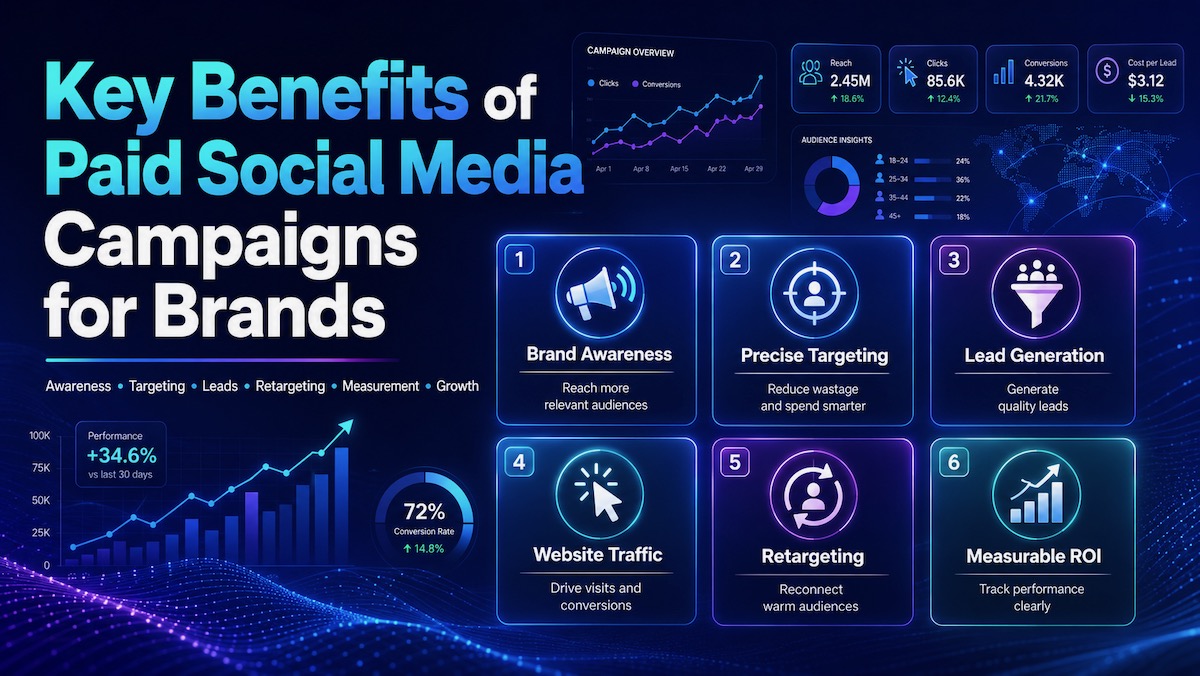
1. Paid Social Media Increases Brand Awareness
Brand awareness is one of the most important reasons to run paid social media campaigns.
People are more likely to trust and consider brands they have seen before. Paid campaigns help businesses introduce themselves to new audiences and create familiarity.
For example, a new brand entering a market may not have enough followers or recognition. Organic content alone may take time to build visibility. Paid social media can help the brand reach thousands or even millions of relevant people in a shorter time.
Brand awareness campaigns are especially useful for product launches, new business categories, new city launches, employer branding, event promotion and campaign amplification.
The goal of awareness campaigns is not always immediate sales. Sometimes, the purpose is to make people remember the brand so that when they need the product or service later, the brand comes to mind.
2. Paid Campaigns Provide Precise Targeting
Targeting is one of the biggest strengths of paid social media advertising.
Instead of showing content to a general audience, businesses can target specific groups of people based on their relevance.
Depending on the platform, targeting options may include location, demographics, interests, behaviour, job title, industry, company size, seniority, education, website visits, app activity, past engagement and customer lists.
This helps businesses spend their advertising budget more efficiently.
For example, a B2B consulting firm can target senior leaders on LinkedIn. An ecommerce brand can target users interested in fashion, beauty, fitness or electronics on Instagram and Facebook. A local business can target people within a specific city or radius.
Precise targeting helps reduce wastage and improves the chances of reaching people who are more likely to care about the message.
3. Paid Social Media Helps Generate Leads
Lead generation is one of the most common objectives of paid social media campaigns.
Businesses can use paid campaigns to collect enquiries from interested users. These leads may come through website forms, landing pages, instant lead forms or direct messages.
Lead generation campaigns are useful for many industries, including real estate, education, financial services, consulting, healthcare, SaaS, recruitment, coaching and professional services.
For example, a company hosting a webinar can run a paid campaign to collect registrations. A real estate brand can generate enquiries for a project. A B2B software company can collect demo requests. A coaching business can generate leads for a programme.
However, businesses should not judge lead campaigns only by the number of leads. Lead quality matters more than lead volume.
A campaign that generates cheap but irrelevant leads may not be successful. A campaign that generates fewer but high-quality leads can deliver better business outcomes.
The right metrics to track include cost per lead, lead quality, lead-to-sale conversion, revenue generated and return on ad spend.
4. Paid Campaigns Drive Website Traffic
Paid social media campaigns can help drive relevant traffic to a website, landing page, blog, product page or campaign page.
This is useful when a business wants people to learn more, read an article, explore a product, download a report or take a specific action.
For example, if a company publishes a detailed industry report, paid social media can help bring relevant readers to the report page. If an ecommerce business launches a new collection, paid ads can drive users to the product pages. If a service business wants to promote a new offering, paid campaigns can send users to a landing page with more information.
Website traffic campaigns work best when the landing page is clear, fast and aligned with the ad message.
If the ad promises one thing but the landing page shows something else, users may leave without taking action.
5. Paid Social Media Enables Retargeting
Retargeting is one of the most powerful benefits of paid social media marketing.
Not every person converts the first time they see an ad. Many users may visit a website, watch a video, engage with a post, open a lead form or add a product to cart but not complete the final action.
Retargeting allows businesses to reach these people again.
This is valuable because warm audiences are usually more likely to convert than completely new audiences.
For example, an ecommerce brand can retarget users who added products to cart but did not purchase. A B2B company can retarget people who visited its service page. A creator can retarget people who watched a large portion of a video. A real estate brand can retarget people who opened a lead form but did not submit it.
Retargeting helps businesses stay visible during the decision-making process.
6. Paid Campaigns Are Measurable
One of the strongest advantages of paid social media advertising is measurement.
Businesses can track how their campaigns are performing in real time.
Important metrics include reach, impressions, clicks, click-through rate, engagement, video views, cost per click, cost per lead, conversion rate, cost per acquisition and return on ad spend.
This data helps marketers understand what is working.
If one audience performs better than another, the budget can be shifted. If one creative has a higher click-through rate, it can be scaled. If a campaign is getting clicks but not conversions, the landing page may need improvement.
Paid social media allows businesses to make decisions based on data, not guesswork.
7. Paid Social Media Helps Test Messaging
Paid campaigns are also useful for testing.
A business can test different headlines, creatives, offers, videos, formats, audiences and calls to action.
For example, a brand can test whether “Book a Free Demo” performs better than “Talk to an Expert.” It can test whether a video ad works better than a static image. It can test whether a discount-led message performs better than a value-led message.
These tests provide insights that can improve not only paid campaigns but also organic content, website copy, email marketing and sales communication.
Paid social media is therefore not only a promotion channel. It is also a learning tool.
8. Paid Campaigns Help Amplify Best-Performing Content
Every brand has some content that performs better than the rest.
It could be a LinkedIn post, Instagram reel, YouTube video, customer testimonial, case study, blog post or thought leadership article.
Paid social media allows businesses to amplify such content to a larger audience.
This is a smart approach because the content has already shown signs of relevance through organic engagement. Instead of guessing what might work, the brand can put budget behind content that has already performed well.
This creates a strong connection between organic and paid social media strategy.
Final Thoughts
Paid social media campaigns help brands increase awareness, reach relevant audiences, generate leads, drive traffic, retarget interested users and measure performance clearly.
They allow businesses to move faster than organic social media alone. More importantly, they help brands connect marketing spend with actual business outcomes.
When used strategically, paid social media advertising is not an expense. It is an investment in visibility, growth and measurable performance.